
Magnetic Resonance Imaging (MRI) has become an essential tool in diagnosing a wide range of medical conditions, offering detailed images of the body’s internal structures without the use of harmful radiation. However, traditional MRI machines often require patients to lie still inside a narrow, enclosed tube, which can be uncomfortable and anxiety-inducing for many. This is where the open upright MRI scanner comes into play, revolutionizing the MRI experience by prioritizing patient comfort without sacrificing diagnostic accuracy. Here, we’ll explore how this innovative technology enhances patient experience while providing precise imaging that aids in better diagnosis and treatment.
What Is an Open Upright MRI Scanner?
Unlike conventional MRI machines that require patients to lie down in a closed, tube-like structure, an open upright MRI scanner offers a more spacious, open design. This design allows patients to be scanned while sitting or standing, rather than lying flat.
The open sides and front provide a less claustrophobic environment, allowing patients to feel less confined and more relaxed during the imaging process.
This technology is particularly beneficial for individuals who experience claustrophobia, anxiety, or physical discomfort when using traditional MRI machines. The ability to remain upright also opens up new possibilities for imaging weight-bearing joints and structures, providing insights that traditional MRIs may miss.
Enhancing Patient Comfort
One of the most significant advantages of the open upright MRI scanner is its focus on patient comfort. Many patients find the confined space of traditional MRI machines stressful or even intolerable. The closed tubes can cause feelings of claustrophobia and anxiety, leading some patients to avoid essential imaging or require sedation.
With the open design of the upright MRI scanner, patients experience a far less intimidating environment. The openness allows for better airflow and the ability to see and communicate easily with the technologist during the procedure. Patients can also adjust their position or move slightly, which is often impossible in traditional MRIs.
Furthermore, for patients with mobility issues, back pain, or other physical challenges, lying flat on a hard MRI table for an extended time can be painful or even impossible. The upright positioning reduces strain and discomfort by allowing them to maintain a natural posture during the scan.
Improved Accuracy Through Weight-Bearing Imaging
The open upright MRI scanner offers a unique advantage in its ability to image the body in natural, weight-bearing positions. This capability can lead to more accurate diagnoses, especially for musculoskeletal and spinal conditions.
Traditional MRI scans are performed with the patient lying down, which means joints and spinal structures are not subjected to the stresses they experience during daily activities. Certain abnormalities, such as disc herniations, spinal instability, or joint misalignments, may not be visible or may appear less pronounced when the body is not bearing weight.
By scanning patients in standing or seated positions, the open upright MRI scanner reveals how these structures behave under normal load. This dynamic imaging provides doctors with valuable information that can lead to more precise treatment plans, including decisions about surgery, physical therapy, or other interventions.
Versatility for Various Clinical Applications
Another benefit of the open upright MRI scanner is its versatility. It can be used for a wide range of diagnostic purposes, including imaging of the spine, knees, hips, shoulders, and other joints. Its ability to scan patients in different positions means it can capture images that reflect real-world conditions and movements.
For example, athletes can be scanned while mimicking the motions they perform in their sports, which may help identify the root cause of pain or injury that traditional MRIs might miss. Similarly, patients with chronic back pain can be evaluated in a way that reveals posture-related issues, contributing to more effective treatment.
Reducing the Need for Sedation and Repeat Scans
Because the open upright MRI scanner reduces patient anxiety and discomfort, it often decreases the need for sedation. This is a significant advantage, especially for children, elderly patients, or those with certain medical conditions that make sedation risky.
In addition, the ability to move slightly and maintain a comfortable position reduces motion artifacts in the images — blurring or distortions caused by patient movement during the scan. This improvement in image quality decreases the likelihood of needing repeat scans, saving time, cost, and inconvenience for patients and healthcare providers.
Enhancing Communication and Patient Experience
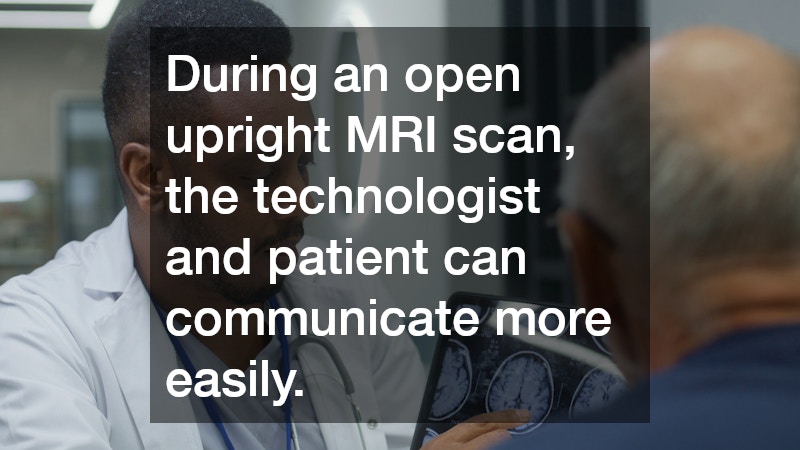
During an open upright MRI scan, the technologist and patient can communicate more easily. The open setup allows the technologist to maintain eye contact, provide reassurance, and give instructions without the barriers typical of closed MRI machines.
This interaction can help reduce patient stress and promote cooperation, contributing to smoother and more efficient scanning sessions. Positive patient experiences encourage adherence to diagnostic recommendations and ongoing care, ultimately benefiting overall health outcomes.
As technology continues to evolve, the open upright MRI scanner stands out as a patient-centered innovation that addresses many limitations of traditional MRI machines. If you or a loved one need an MRI and have concerns about comfort or accuracy, discussing this option with your healthcare provider could lead to a better imaging experience and improved care outcomes.